Introduction
Research is of two types: Desk research and Active research Desk research is where we read, review and digest written media from Newspapers, Websites, Magazines, Competing Events. Active research is where we actively canvas key attendee profiles. This is the most challenging and valuable research. It is also the most difficult to execute

What and why
- Testing the hypothesis. At a fundamental level we use research to validate or refute our proposition and concept.
- Problems and opportunities. We discover the really big issues and opportunities facing the sector / discipline.
- Topics and Bullets. The above is developed into the guts of our agenda.
- Potential Speakers and Panellists.
- Potential Sponsors.
- Marketing Channels and Media
- Referrals for further research.
Using a notebook and pencil
Set up a note book according to the following headings in MindMap style (with a circle in the middle of the page):
- Competitor Intelligence
- Research sources – webs, magazines, newspapers
- Big headings
- Topics and bullets
- Speaker ideas – with emphasis on keynotes

Some fundamentals
Always address the “right” questions to the “right” people. If you address inappropriate questions to inappropriate targets you will never garner any insight. This is obvious. But in many cases in our industry research is conducted in this inappropriate manner.
Number of research calls:
- For a Start Conference – 30 calls
- For a Big Conference – 50 calls

Using surveys
We have recently started using surveymonkey (www.surveymonkey.com) as an adjunct to our research process. There is an art to devising the survey questions. Most importantly, start with the answers you seek before you draft the questions. It’s the answers that you emerge with that will really drive our production, sales and marketing efforts. The surveys themselves are fairly straight forward with usually no more than 10 mostly agree/disagree responses. They do not overtly mention any conference but appear to be sincere research on an important industry issue. We select the relevant buy-side data and promise every survey respondent a copy of the collated results. In some instances, we offer genuine end users a free pass to a conference on the subject matter. This solves a major, and growing, issue in matching the buy-side and sell-side attendees at our events. The survey usually runs for 36-48 hours after which we close it and compile the results. The results are written up and used across all media (web site, press releases, exproms, confproms, sponsorship proposals, speaker invitations, research prompt sheets, sales prompt sheets, dear exec letters etc).
The results typically aim to demonstrate the following:
- What are the key challenges facing the buy-side attendees
- How they currently address these challenges
- What are the obstacles to overcoming these challenges
- What are the key opportunities facing the buy-side attendees
- How they currently develop these opportunities
- What are the obstacles to overcoming these opportunities
- Who they usually turn to for solutions (a list of their suppliers)
- What they look for in choosing a supplier
- What their buying intentions, budgets, timelines are
The size of the sample pool is irrelevant. Our recent examples have yielded a range of responses between 60 and 250. It’s the statistics that count and moreover the answers that will hopefully stimulate our clients into giving serious time to our phone calls and face to face meetings.
More than anything it’s a big differentiator and genuine credibility builder.
Make the calls!
Use SPOIN in conference research
Want to develop great conference content that leaps out off the page and speaks directly to your attendees’ business aspirations?
Then you need to really understand and deliver on their needs.
Use the principles of Huthwaite’s “SPIN™ Selling” to guide your research – a powerful methodology for uncovering the needs and wants of your prospects and customers.
The steps of the process are very simple:
- Understand your attendee profiles and plan questions around their potential business challenges and opportunities
- Ask probing questions around these areas
- Push for detail and clarity on the implications and consequences
- Build a sense of where the value would lie for the attendees in addressing these issues
- Record the results and use them to drive the focus and agenda of the conference.

How to conduct conference research using SP(O)IN questions
There are four types of questions to use during your research calls:

1. Situation Questions
Use these to uncover relevant facts about the prospect’s business. Don’t ask too many – use them mainly to clarify or understand something your prospect has said.
- What is your role?
- How is your team structured?
- Where are your major markets?
- What are the major elements of your procurement / manufacturing / investment process?

2. Problem and Opportunity Questions
Use these to uncover information about their significant challenges or objectives.
Plan your questions around areas that you know from your brief and ongoing research are relevant for the topic. General questions might include:
- What pressures are businesses like yours under at the moment?
- What challenges do you face in your role?
- How happy are you with the department’s performance over the last 12 months?
- What are your key objectives?
- Where are you looking to take the business / your area of the business next?

3. Implication Questions
Use to explore the consequences (good or bad) of these problems and opportunities These questions are important - they help uncover just how much a problem or opportunity means to a prospect and why. Again, many of these consequences will be topic specific. There are some simple general implication questions to use if you are unsure:
- How serious is the problem? What other effects does it have?
- Why does this matter? How important a problem is it?
- How much of a priority is this?
- What would delivering on this opportunity mean for the business?
- Tell me more about the impact of this?

4. Need Payoff Questions
Use these to ask about the benefits (payoff) of solving the problem or of potential solutions You can ask about two types of solutions: Questions that relate to vendor solutions in the market
- So would it be helpful if you were able to outsource much of this process to an offshore supplier for example?
- Are you looking for some form of software automation system then to help overcome this issue? Questions that ask about the value of your event in helping them address these issues
- Would it be valuable for you to hear from others who have been looking at these same issues?
- What would be the most useful information?
- How useful would it be to be able to discuss potential ways of meeting that opportunity with peers from the US market?
This way you can identify the prospect’s “explicit needs” – for both solutions and information – that we should be looking to deliver at the event.
Tips for using SPOIN questions in your research
- Always clarify and extend... Keep diving deeper - get right to the heart of the issues. Don’t stay at a surface level – Ask your prospect to expand, clarify and explain in more detail.
- Tailor your approach... some people are more willing to talk in terms of problems or challenges whilst others use the language of opportunity and aspiration. Be flexible and follow your client’s lead in directing the conversation.
- Keep your questions simple... if it feels like you’re struggling to ask a really detailed specific question, chances are you’re overcomplicating! Start with general questions if need be that allow them to open up about their general challenges or opportunities and then move into more detailed topic specific questions as your conversation builds momentum.
- Be honest with your intentions... this process is not a trick. Explain you are establishing where there may be a fit between their business goals and the areas being covered by the event. Our desire to understand and deliver on customer needs is what sets us apart form our competition and we’re proud of that fact!
- Check you’ve covered everything... close by asking the most obvious question of all...is there anything else they would like to discuss that hasn’t already been covered

Using the T Form
Record the information you uncover! Effective note taking is an essential habit for success in research. Make life easy for yourself - use the “Primary Market T Form” to record vital pieces of information about your prospect’s situation and needs. You will find more instructions about this form and how to use it.........

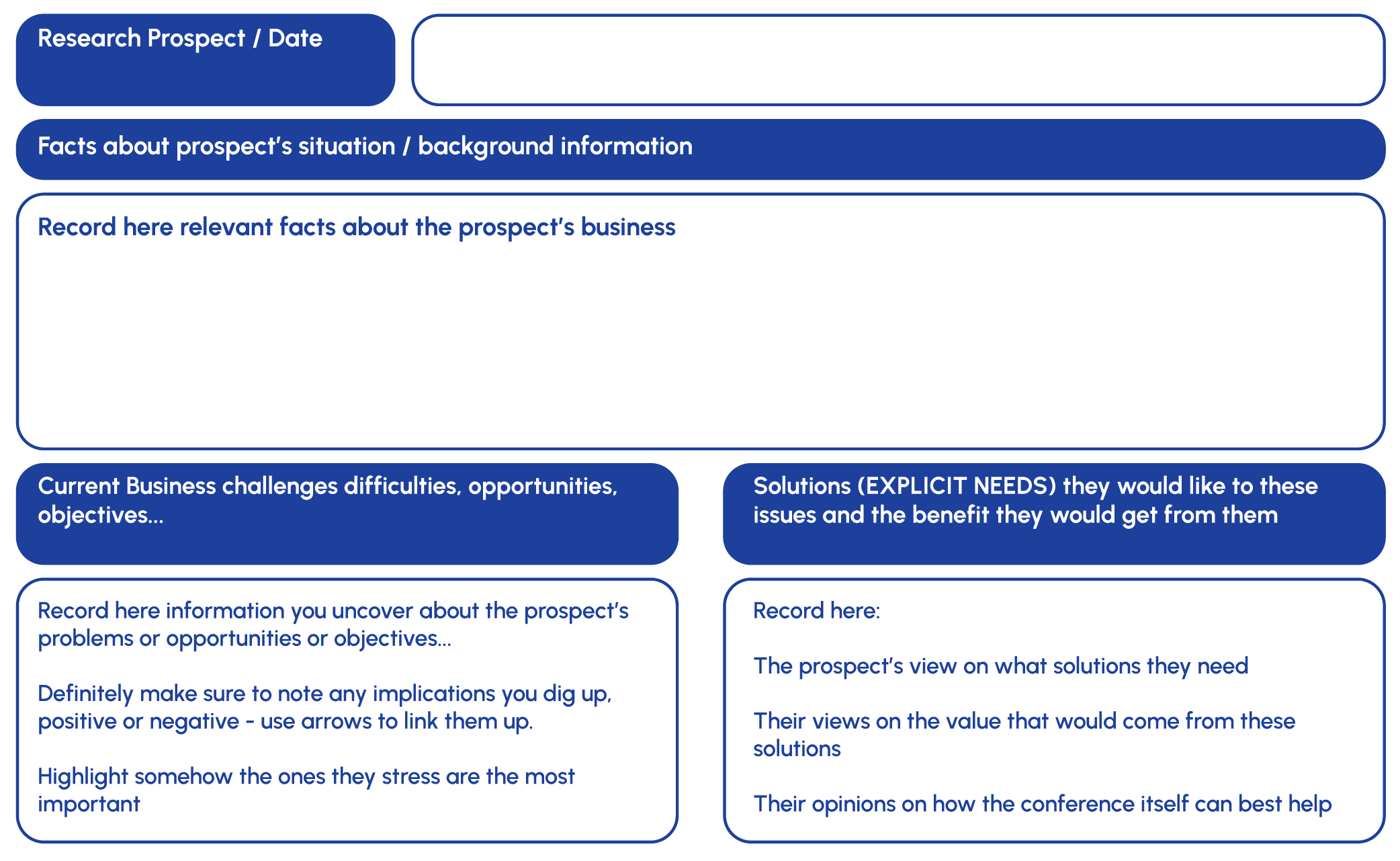
Tips on using the T Form to capture important information about customer needs
- Print off blank T Forms and use them on your calls
- Organise your T Forms for a particular event in a folder, organised alphabetically by prospect company: as you progressthrough your research you will have a valuable record of your conversations to hand at any time to help you plan your next steps and conference content
- Ask for permission to take notes at the outset
- Write by hand - it’s impossible and rude to write notes on a computer while you are talking to someone
- Use a highlighter pen or circle comments or keywords that strike you as important: that way you can come back to them at a later point if need be.