Using spin to investigate customer needs

Want to sell high value sponsorship packages and build long term relationships with your clients?
To do this effectively the single most important step you can take is to really understand and deliver on our customers’ needs and expectations.
- Get inside and understand our customers’ businesses – their problems, objectives and goals
- Work with them to deliver powerful and effective solutions to their needs
- Differentiate ourselves from our competition through our focus on customer needs
- Create long term value for our clients
Our process for uncovering customers’ needs is based on the principles of “SPIN™ Selling” – a powerful methodology for high value consultative sales, developed by Huthwaite.
How do we assess needs using conference-focused SPIN questions?
1
Situation Questions – use these to uncover relevant facts about the prospect’s business.
Don’t ask too many – keep them focused on key areas. Also use them to clarify or understand something your prospect has said.
- What products are you marketing to this audience group at the moment?
- Who are your target audience in terms of vertical sectors / job titles?
- What is the organisation’s brand message in the current quarter?
- What is the average deal size or cost of your product or service?
- Which are your biggest competitors?
2
Problem and Opportunity Questions – use these to uncover information about their significant challenges or objectives. These will uncover your customers’ Implied Needs
There are dozens of questions you can ask. Plan some around areas you are relevant from your research.
Good general questions include:
What are your objectives or challenges in:
- Building business for investment in a new product or service
- Brand positioning or awareness
- New business development and face to face networking
- Managing existing client relationships
Some others:
- Are you satisfied with your current level of market share?
- What opportunities are there to improve brand perception amongst your customers?
- Do your salespeople find it difficult to engage with the appropriate level of decision maker?
- What are your objectives for the new product launch?
- Where are you trying to take the business next?
3
Implication Questions – use to explore the consequences (good or bad) of these problems and opportunities
These questions are important - they help uncover just how much a problem or opportunity means to a prospect and why. Some of these consequences will be topic specific. Otherwise use simple general implication questions:
- How serious is the problem? What other effects does it have?
- How much of a priority is this?
- What would solving this problem mean for the company?
- If you could achieve that objective, how much would you expect sales to increase by?
- Does the low level of brand awareness make it difficult for your salespeople to book appointments with prospects?
3
Need Payoff Questions – use these to ask about the benefits of solving the problem by the sorts of solutions your event offers.
These will help you find explicit needs – needs the customer has told you they have for elements of your solution.
- So would it be valuable then to have your senior executives seen in the company of leading industry innovators?
- If your logo and brand was heavily linked with this topic through our extensive marketing campaign…would that help?
- What could you achieve through significant face time with this level of prospect?
General ways to ask:
- Would it be valuable to?
- Would it help if?
- What do you think you need to achieve that?

Seven tips for effective questioning and needs assessment:
1
Use a good balance of questions…
the most effective sales people ask more implication and need payoff questions. These questions help the prospect recognise the full value of a solution!
2
Be natural and listen to your prospect…
you don’t have to ask the questions in a set order of S, P, I then N. Have a real conversation…focus on what they are saying; ask for clarification; respond with relevant questions that follow from what they’re saying.
3
Tailor your approach...
some people are more willing to talk about problems or challenges whilst others use the language of opportunity and aspiration. Be flexible and follow your client’s lead
4
Ask about ROI!
Always ask how your prospect will calculate ROI from investment in the conference. Explain how important it is for us to be able to work with clients and ensure they get the most out of their investment.
5
Keep your questions simple…
if it feels like you’re struggling to ask a really detailed specific question, chances are you’re overcomplicating!
6
Be honest…
this is not a trick. Explain you are establishing if there is a fit between their business goals and the solutions your event offers. Our desire to understand and deliver on customer needs is what sets us apart form our competition and we’re proud of that fact!
7
Ask about investment range and budget process…
before you can say you’ve fully investigated their needs you need to have some insight here. Otherwise you could end up proposing something wildly in appropriate. The earlier you can establish this sort of information the better.
Always search for Explicit Needs!
Customers have two types of needs – implied and explicit. We should be working all the time to uncover as many explicit needs as possible – the key to success in high value sales.
To motivate our customers to buy, we need to explore and develop these problems or opportunities so they translate into a clear desire for a solution we have – an Explicit Need.
The difference is subtle but important…Use intelligent and probing questions to explore issues with our clients to the point where they have stated one or more explicit needs for solutions that our event can provide. Think about it – by doing this, you’ve got them to tell what they want from your event and why they need it!

HOLD YOUR FIRE!
A common mistake made by salespeople is to present their solution or the features of their product or service too early. Especially when we have uncovered implied needs. Be careful. Until your customer has stated an explicit need and you have explored the value from meeting it, your customer will be much more likely to raise objections to any solution you propose!
Check you’ve covered everything.
Before presenting any solution, always:
- Summarise what you’ve discussed
- Check that there is anything they can think of that’s missing
- Outline our customers’ typical needs - brand positioning, building the business case, face to face business development and relationship management – ask which of these if any they have needs that have not yet been discussed

Plan your questions – put yourself in your customers’ shoes!
Plan your questions around the kinds of problems and opportunities vendors have in the area covered by your conference. This will get you started in your conversations and make you sound highly credible. When you start a sales campaign, work with your General Manager and the Conference Manager to complete a Vendor Profile Analysis form for the most important target vendor groups. Identify their common challenges, objectives and implications- plan questions to explore them.
Record the information you uncover!
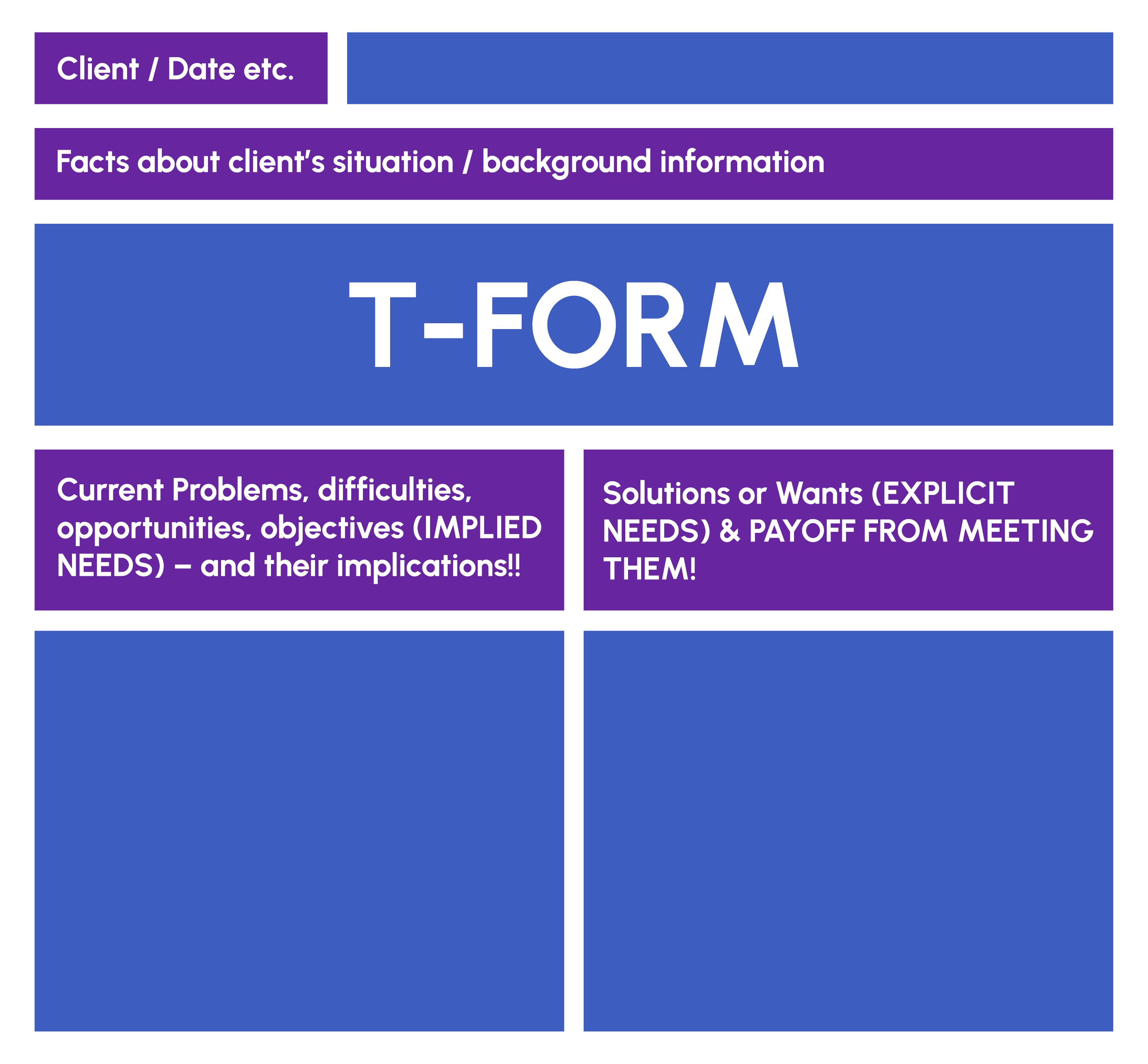
There’s no point in uncovering a host of information about customer needs and the value of your solution if we don’t put it to effective use. Effective note taking is an essential habit for success in sales. Make life easy for yourself - use the “T Form” to record vital pieces of information about your prospect’s situation and needs